
PATELLAR TENDON PAIN / RUNNER'S KNEE TREATMENT & REHABILITATION
Many athletes continue training with knee pain for weeks before seeking help, particularly if symptoms initially seem manageable.
However, persistent knee pain, swelling, or mechanical symptoms such as catching or locking can indicate an underlying joint injury that benefits from accurate assessment and rehabilitation.
A structured sports injury assessment can help determine the source of the problem and guide an appropriate rehabilitation programme.
PATELLA TENDONITIS | CHELTENHAM
What Is Patellar Tendon Pain?
Patellar tendon pain, often referred to as jumper’s knee, is a common overuse injury affecting the tendon that connects the kneecap (patella) to the shin bone.
This tendon plays a critical role in running, jumping, and explosive lower limb movements, helping transmit force through the knee during athletic activity.
Patellar tendon pain often develops gradually when the tendon is exposed to repeated loading that exceeds its ability to recover, which is common in sports involving running, jumping, or rapid changes in direction.
At Proview Sports Injury Clinic in Cheltenham, we regularly assess athletes experiencing patellar tendon pain. Our approach focuses on accurate diagnosis, progressive tendon loading, and restoring full athletic function.
Common Symptoms of Patellar Tendon Pain
Athletes experiencing patellar tendon pain may notice:
• pain at the front of the knee just below the kneecap
• discomfort during running, jumping or squatting
• stiffness in the knee during or after activity
• tenderness along the patellar tendon
• symptoms that worsen with increased training load
Because several structures can cause pain at the front of the knee, an accurate sports injury assessment is important to determine whether the patellar tendon is involved.
Why is tendon rehabilitation different from muscle rehabilitation?
Tendons and muscles are made from different types of tissue and respond to training in different ways.
Muscle tissue is primarily made from protein fibres, which can adapt relatively quickly to strengthening exercises.
Tendons, however, are made largely from collagen, a dense connective tissue that transmits force from muscle to bone. Because of this structure, tendons adapt more slowly and require carefully progressed loading exercises to rebuild strength and resilience.
For athletes with patellar tendon pain, rehabilitation typically focuses on progressive loading programmes that gradually increase the tendon’s capacity to tolerate running, jumping and sporting activity.
This is why tendon rehabilitation often takes longer than muscle recovery, but structured loading programmes are essential for restoring tendon health and preventing recurrence.

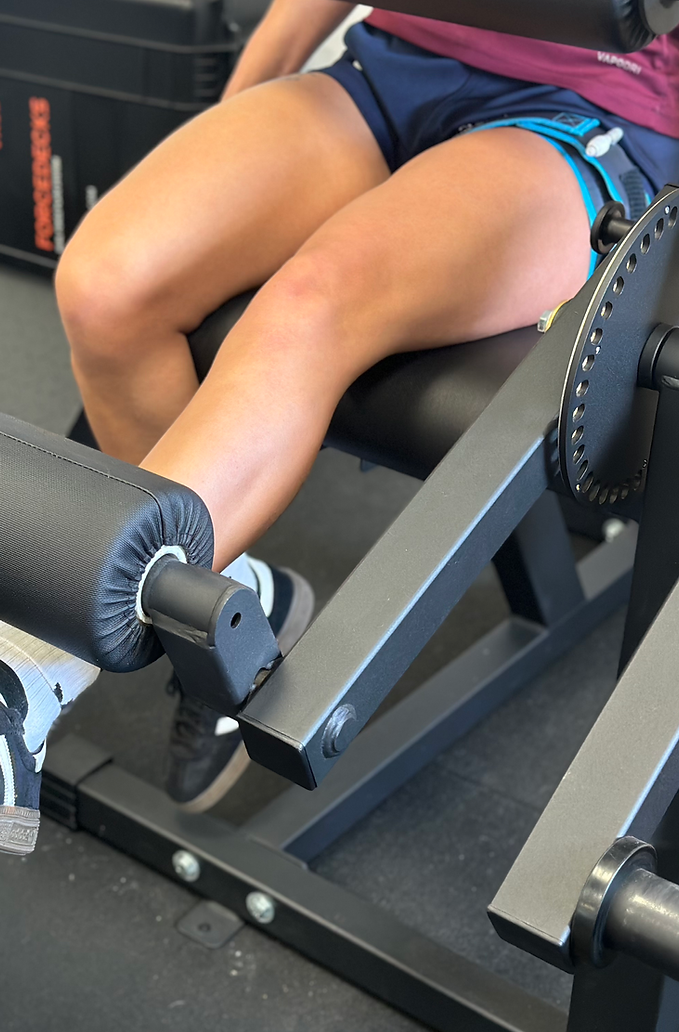
How Patellar Tendon Injuries Occur in Sport
Patellar tendon pain most commonly develops in sports involving repeated jumping and high-load knee extension movements.
These injuries are frequently seen in:
• running athletes
• football and rugby players
• basketball and volleyball athletes
• gym and strength training environments
In many cases the tendon becomes irritated when training load increases too quickly, or when underlying strength or movement deficits place excessive stress on the tendon.
Our clinicians assess not only the tendon itself but also the surrounding biomechanics, strength capacity, and movement patterns that may contribute to tendon overload.
HOW WE ASSESS PATELLAR TENDON INJURIES
Assessment begins with a detailed sports injury consultation, where we review your symptoms, training history and the specific demands of your sport.
During assessment we may evaluate:
• knee range of movement
• quadriceps and lower limb strength
• tendon load tolerance
• movement mechanics during squatting and jumping
• single-leg control and stability
Alongside assessing the knee itself, we also evaluate biomechanical factors that may contribute to tendon overload.
This includes assessing hip strength and control, as well as foot and ankle mechanics, which can influence how load is transferred through the knee during running, jumping and change-of-direction movements.
Identifying these contributing factors helps us understand why the patellar tendon has become overloaded, allowing rehabilitation to address the underlying cause rather than simply treating the symptoms.
Where appropriate we also utilise force plate testing and performance profiling to assess lower limb strength and identify asymmetries that may contribute to tendon overload. This allows us to design a data-driven rehabilitation programme tailored to the athlete.
PATELLAR TENDON REHABILITATION
Rehabilitation for patellar tendon injuries follows a structured progression designed to restore tendon capacity, rebuild lower limb strength, and prepare athletes for a safe return to sport.
PHASE 1 — RESTORE LOAD TOLERANCE
The first phase focuses on reducing tendon irritation while restoring comfortable knee movement and reintroducing controlled loading.
This phase may include:
• controlled isometric loading exercises
• early quadriceps activation
• mobility work for the knee and surrounding joints
• guidance on modifying training load
The goal during this phase is to restore comfortable movement and begin rebuilding tendon tolerance to load.
PHASE 2 — STRENGTH AND MOVEMENT CONTROL
As symptoms settle, rehabilitation progresses toward rebuilding strength and stability throughout the lower limb.
This stage focuses heavily on quadriceps strength, which plays a key role in supporting the patellar tendon during running and jumping.
This phase may include:
• progressive quadriceps strengthening
• hamstring and glute strengthening
• single-leg strength exercises
• neuromuscular control and stability work
During this stage we also begin addressing movement patterns or strength deficits that may have contributed to tendon overload.
PHASE 3 — RETURN TO SPORT PREPARATION
For athletes returning to sport, rehabilitation must restore the knee’s ability to tolerate high-load and explosive movements.
At this stage we utilise force plate testing and performance profiling to objectively assess lower limb strength and identify any asymmetries between limbs.
Return-to-sport rehabilitation may include:
• plyometric loading progressions
• jumping and landing drills
• agility and multidirectional movement training
• strength and power testing using force plate technology
Using objective data allows progression based on performance markers rather than time alone.
PHASE 4 — RETURN A STRONGER AND MORE RESILIENT ATHLETE
The final phase focuses on ensuring athletes return to sport with improved movement quality and reduced injury risk.
At this stage we identify and address any underlying mechanics or movement patterns that may have contributed to the injury.
This may include:
• correcting strength asymmetries between limbs
• refining jumping and landing mechanics
• improving lower limb force production
• enhancing sport-specific movement patterns
Our goal is always to return athletes stronger, more resilient, and better prepared for the demands of their sport.


SUPPORTING REHABILITATION WITH SPORTS THERAPY
Alongside structured rehabilitation exercises, sports therapy and manual treatment can help support recovery from patellar tendon pain.
Manual therapy may include:
• soft tissue treatment for the quadriceps and surrounding muscles
• techniques to reduce muscle tension around the knee
• joint mobilisation to support knee movement
These treatments can help improve movement quality and reduce discomfort while the athlete progresses through rehabilitation.
Learn more about our Sports Therapy services here.
ONLINE PATELLAR TENDON
REHABILITATION SUPPORT
For athletes who cannot attend the clinic in person, we also offer online injury assessment and rehabilitation support.
Through remote consultations our clinicians can assess your symptoms, review your training history and guide you through a structured rehabilitation programme.
Online rehabilitation may include:
• injury assessment and training history review
• personalised strength and rehabilitation programming
• movement analysis using video footage
• progressive loading guidance
• return-to-sport planning
Learn more about our Online Rehabilitation services here.
RETURN-TO-PLAY FORCE PROFILING
For athletes who have completed rehabilitation elsewhere but want reassurance before returning fully to sport, we offer force plate profiling and return-to-play testing.
Using objective testing we assess lower limb strength, force production and limb symmetry, helping identify any remaining deficits that may increase injury risk.
This allows return-to-sport decisions to be guided by objective performance data rather than time alone.
Learn more about our Force Plate Profiling service here.
BOOK A PATELLAR TENDON
INJURY ASSESSMENT
If you are experiencing pain below the kneecap during sport or training, our sports injury specialists can assess the injury and guide your rehabilitation.
Book a Sports Injury Assessment at Proview Sports Injury Clinic in Cheltenham to begin your recovery.


PATELLAR TENDON PAIN FAQ
What is jumper’s knee?
Jumper’s knee is another term for patellar tendon pain, typically caused by repeated jumping or high-load knee movements.
Can I run with patellar tendon pain?
Some athletes can continue modified training, but running through worsening symptoms may delay recovery. Assessment can help determine appropriate loading levels.
How long does patellar tendon rehabilitation take?
Recovery varies depending on symptom severity, but structured tendon loading programmes often require several weeks to months to fully restore tendon capacity.
Can physiotherapy help patellar tendon pain?
Yes. Rehabilitation focusing on progressive loading, strength development and movement mechanics is the most effective approach for many athletes.
Should I stretch patellar tendon pain?
Stretching can help improve flexibility in the muscles around the knee, such as the quadriceps and hips, which may influence how load is transferred through the joint.
However, stretching alone does not address the underlying cause of patellar tendon pain.
The tendon typically requires progressive strengthening and loading exercises to rebuild its capacity and tolerate activity.
For many athletes, rehabilitation focuses on structured tendon loading programmes rather than relying on stretching alone.